When ValuSource CEO David Fein attended the Global Excel Summit in London in May 2026, he came away with many valuable insights and connections. One such connection was with Giles Male, an expert in financial modeling who can offer lessons for business valuation professionals.
Male is the co-founder of Full Stack Modeller, which offers Excel training for financial professionals, and of the Excel UK Championship. He’s one of only three individuals who are both Microsoft Most Valuable Professionals (MVPs) in Excel and recipients of the Master Financial Modeler accreditation from the global Financial Modeling Institute (FMI).
Microsoft has designated about 150-160 Excel MVPs worldwide, who were nominated for adding value to the Excel community. Eight individuals have been awarded MFM status, for achieving the pinnacle of financial modeling experience, skill leadership, and contributions to the field.
In a recent interview, Male discussed the interplay between sound practices for financial modeling and those for valuation, and the growing influence of AI.
Male stressed the importance of best practices in financial modeling, as well as for other users of Excel, many of whom are self-taught.
“The FMI doesn’t prescribe a single way of doing things, but best practices are so important,” he said. “It’s easy for one thing to be wrong in a big workbook and go undetected.”
Best practices are also important when you have a team working on a model. “If everyone’s following the same approach, and someone leaves and is replaced, the replacement can pick up the model right away.”
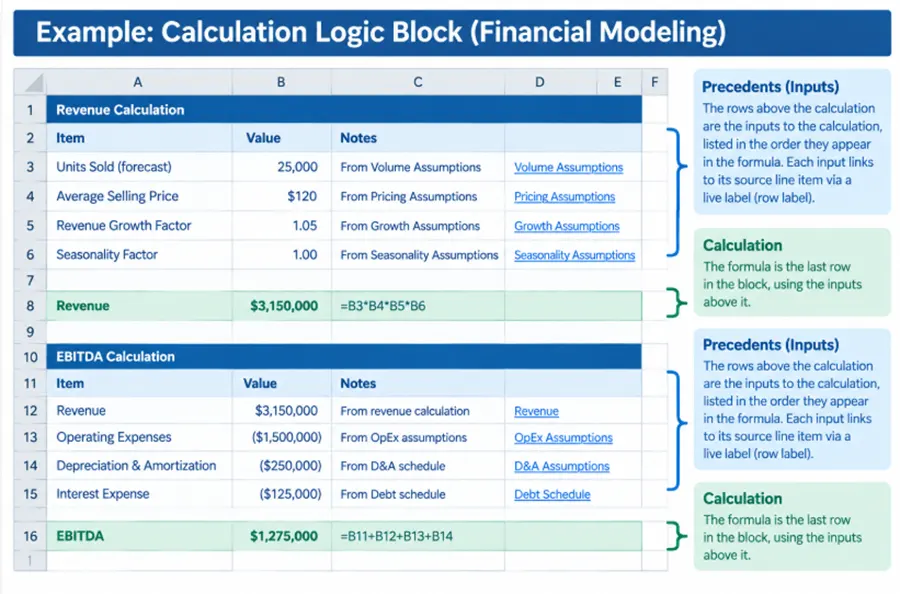
One Excel best practice business valuators can learn from expert financial modelers is the use of calculation block logic. According to Male, this principle involves breaking calculations into separate steps and structuring your worksheets in a way that makes it easy for other users to follow your logic. Every calculation is done in a separate calculation block.
“When you build a big financial model to get to cash flow, an income statement, a balance sheet, and a bunch of metrics, you have 10-15 schedules behind it,” Male said. “Calculation block logic breaks those out into little modules.”
Generally, a calculation block has a single calculation presented in its last row. The rows above show the precedents to the calculation, listed in the order they appear in the formula. Each precedent should link to the source line item, with links to the source line item’s row label (what’s known as live labeling). The precedents are separated by blank rows above and below that visually separate them from adjacent calculation blocks.
“It’s hard to quantify how much value is gained from always being able to quickly and confidently explain your logic,” Male said, “but I’d say it’s almost priceless.”
He also recommends that valuation professionals learn how to use flags and factors in Excel. “Flags are binary 1s and 0s to turn things on or off in periods (for example, whether a certain assumption should apply in a period). Factors are decimal numbers that can make adjustments for things like inflation and seasonality.”
For example:
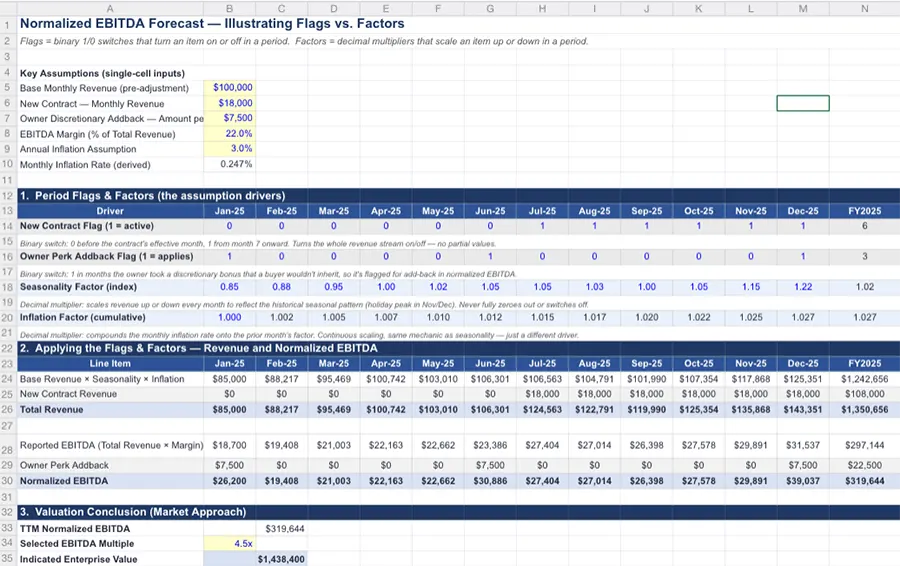
The yellow cells represent the valuator’s inputs. The grey cells are flags (on/off), and the blue cells are factors.
“AI tools are starting to become more useful,” Male said. “For example, some tools take base large language models and add a financial modeling context. I’m not saying these tools are underused yet, but we’re getting to that tipping point.”
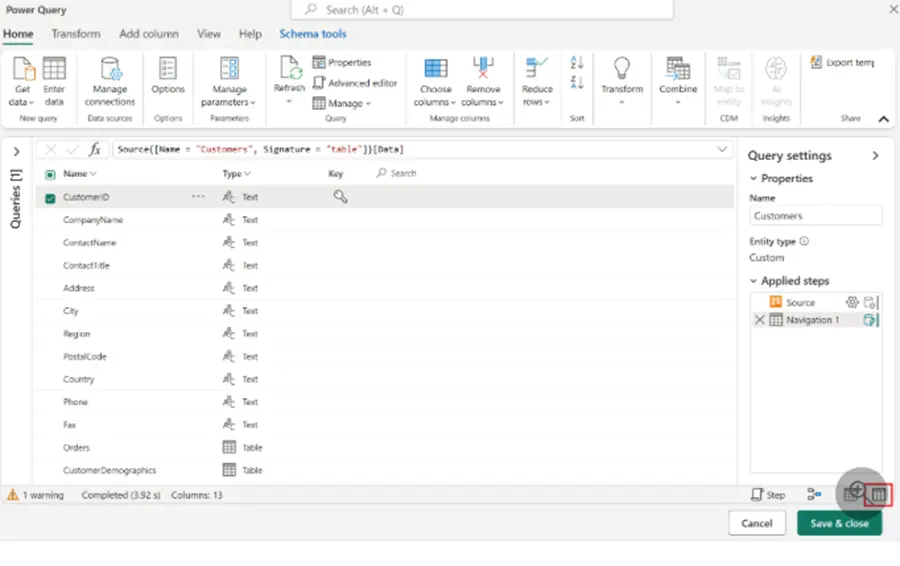
Automation of repetitive Excel is another growing area and probably the primary area where Male is currently seeing AI value. “The first thing to do is to use something like Power Query for any task that involves pulling data,” he said. Power Query lets users import and reshape data from within a range of Microsoft products, including Excel, and saves the transformation steps as a repeatable query that users can refresh.
Male assured valuators that Power Query isn’t too sophisticated for them to easily apply. “The best thing about it is that it has a user interface, so you don’t have to code. You can just hit the right buttons to tell it what to do. There’s a big learning curve if you want something very bespoke, but 95% of users don’t need that.”
AI can prove useful when it comes to reviewing financial models, too. “Some valuators build a model and then just leave it,” Male said. “They don’t review it or dig deeper to make their models less error prone.
He advises valuators to run their models through AI — as long as they don’t treat the result as the final answer. “I’d prompt AI to tell me about the model, including any weaknesses, technical errors, etc. It might not find everything, but that’s a massively efficient first step.”
Mare also recommends products like Perfect XL and Operis Analysis Kit (OAK) for reviewing models. These tools don’t currently employ AI but can provide critical insights on your valuation models.
Improve Your Practice
Every valuation professional understands how vital Excel is to their work. Adopting some of the practices used by top-tier financial modelers can only make it more powerful and efficient.